{{ variable.name }} : {{ variable.values[selectedVariantsIndex[variable_index]].name }}
Quantity:
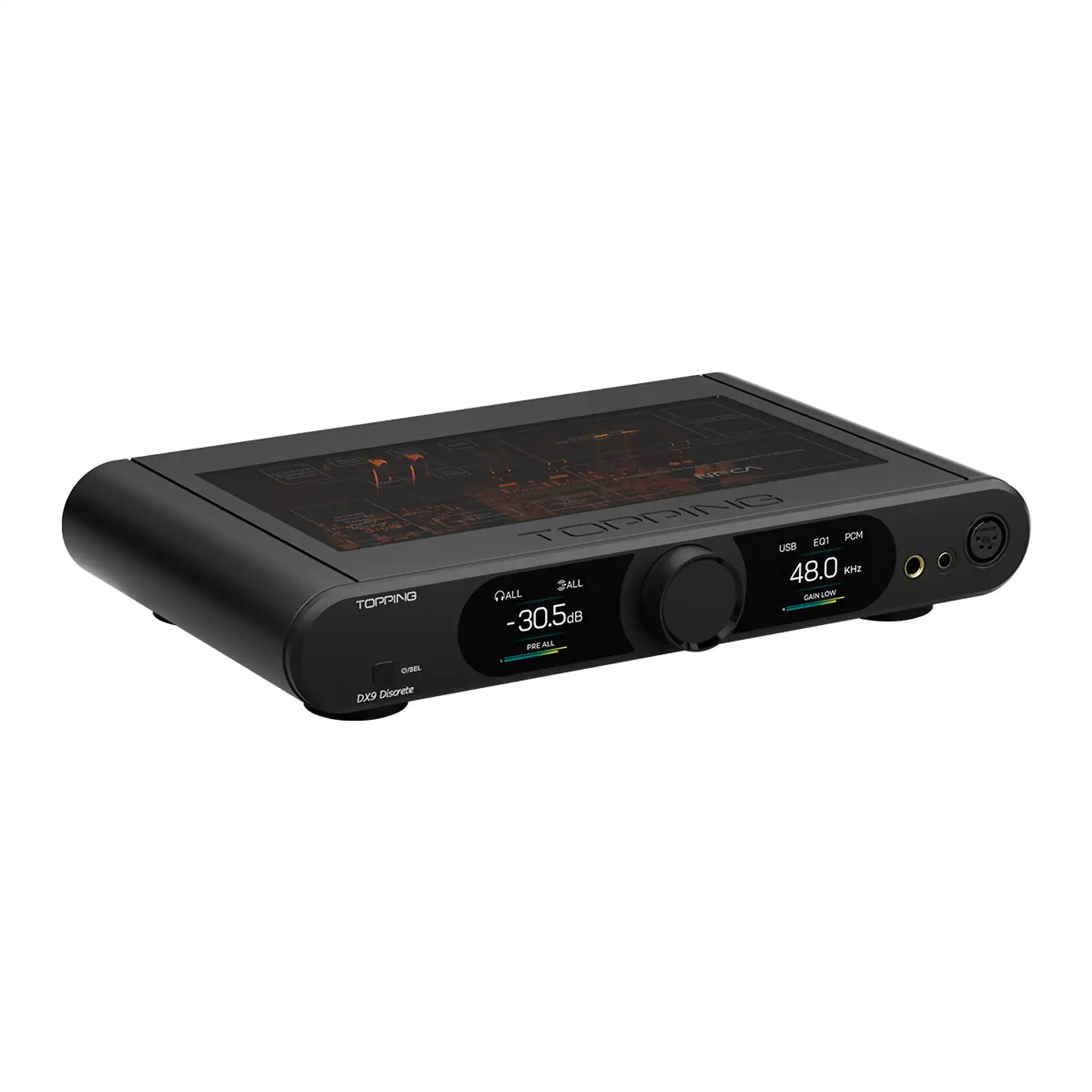
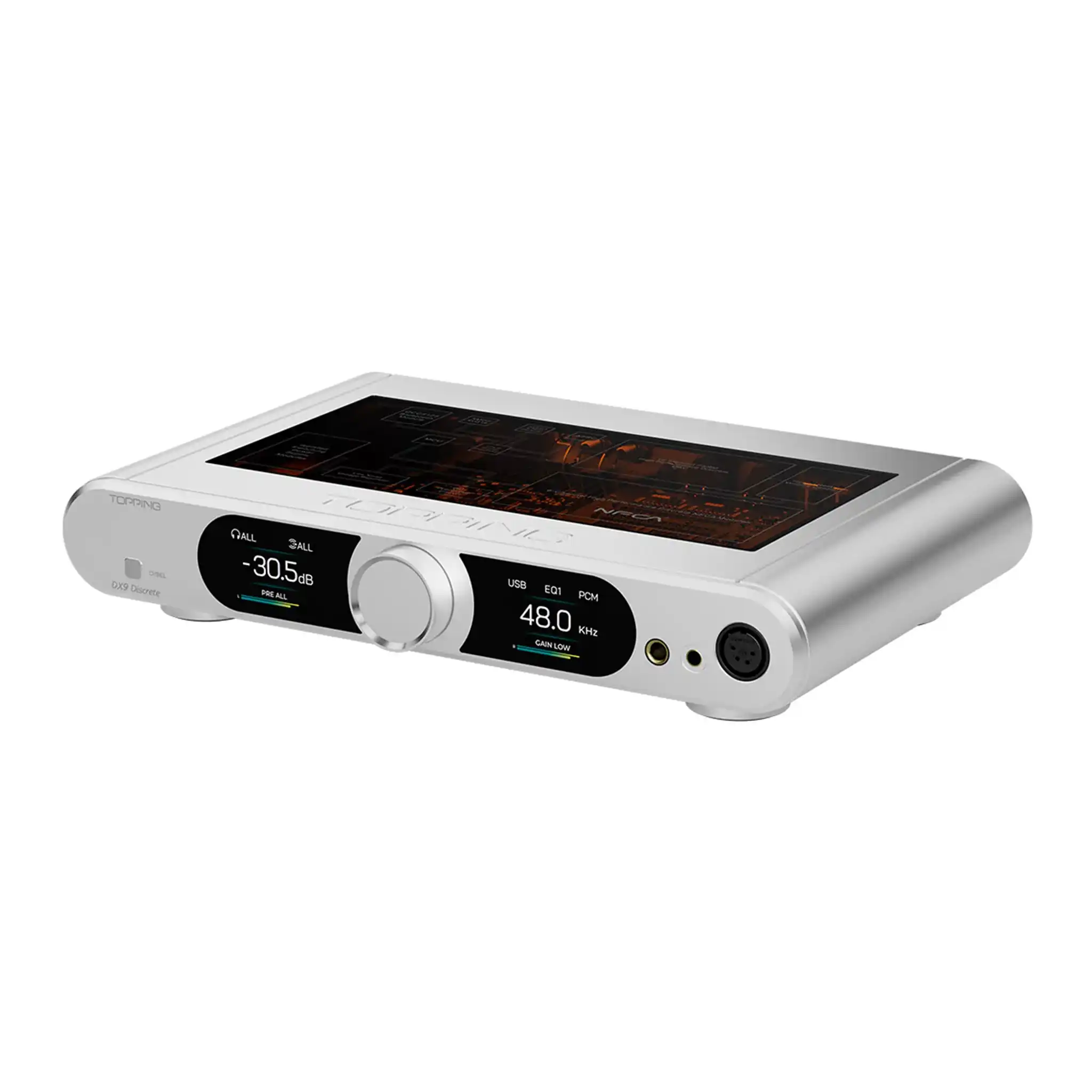
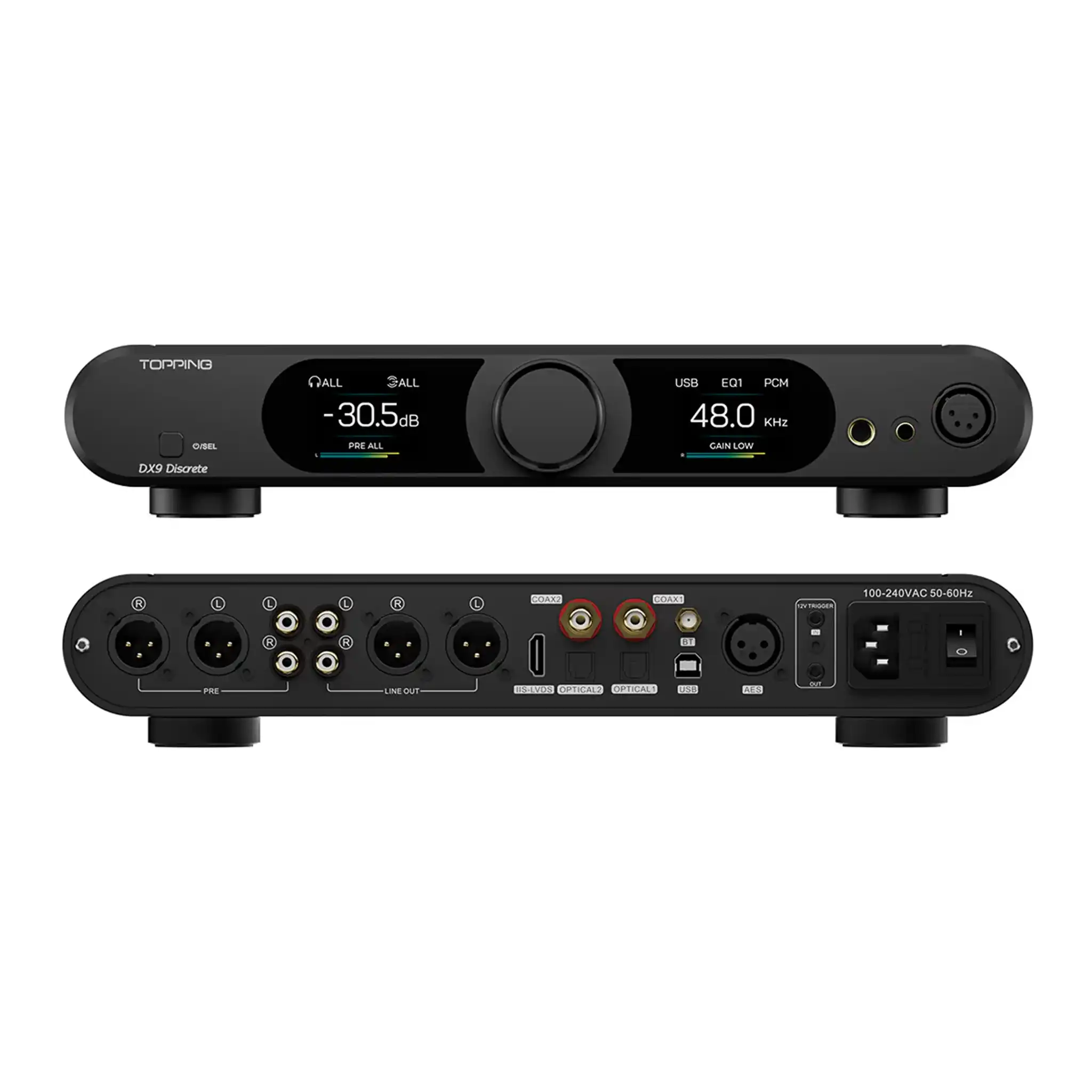
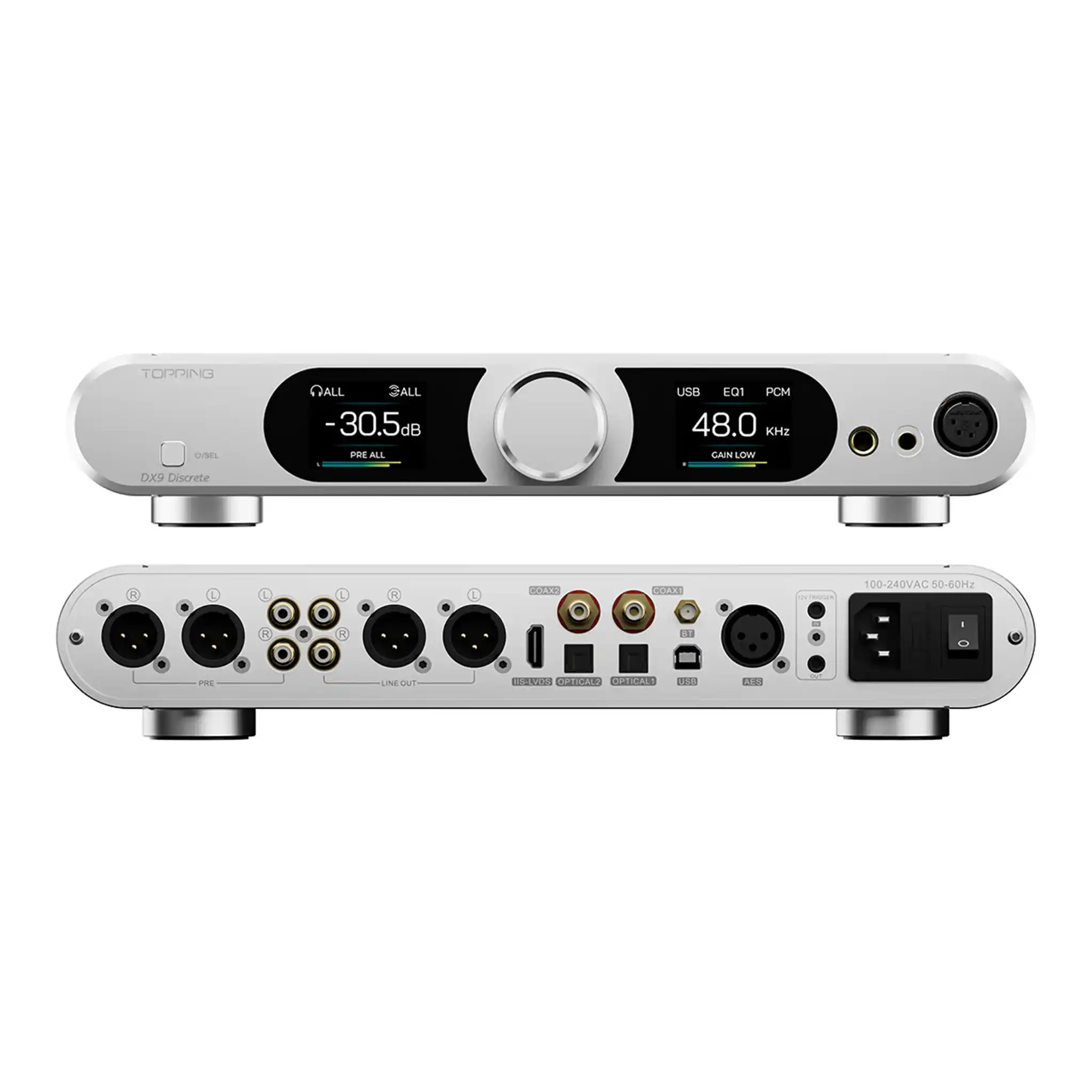
The DX9 Discrete employs a 16-element PSRM module for each channel, meticulously selected to ensure ultra-fast response, superior signal integrity, and minimal power interference. This precision engineering enables the DX9 Discrete to achieve exceptional fidelity, boasting a remarkable 131dB dynamic range and 131dB signal-to-noise ratio.
A CPLD paired with a precision clock optimizes the digital signal and performs dual-stage amplification. This achieves deep jitter suppression and reduces artifacts to near zero for clearer, more defined vocals and instruments.
The AK4118 receiver handles coaxial, optical, and AES inputs, delivering ultra-clean digital signal with jitter as low as 50 ps RMS, supporting up to 768kHz PCM and DSD512. In a commonly used jitter test, DX9 Discrete reaches jitter levels as low as -160dB.
Designed for ultimate sound, the custom I/V conversion optimized for PSRM combines low-distortion op-amps with low-noise discrete components to process signals with precision. This fully unlocks the music's dynamic potential, delivering ample dynamics and an immersive sound experience.
The hybrid relay-resistor network delivers ultra-precise volume adjustment, eliminating channel imbalance at low volumes in balanced outputs and ensuring pinpoint vocal imaging. By combining relay switching with digital volume control, it achieves lower distortion and superior noise immunity. The result is music with greater purity, accuracy, and realism.
A convolution-based crossfeed precisely models HRTF and room acoustics, delivering dramatically improved imaging accuracy and spatial depth. The result is a more natural soundstage with reduced in-head localization and the close-ear effect typical of traditional headphone listening.
Meticulous tonal calibration ensures the system maintains both tonal integrity and realistic spatial presence, avoiding the artificiality that can arise from simply flattening the frequency response. For those who prefer a gentler, speaker-like experience, an enhanced BS2B-based simplified mode is also available, offering a relaxed, natural presentation without relying on room reflections.
Topping’s new PEQ system introduces ten fully customizable frequency bands, powered by a newly developed algorithm and intuitive desktop software. Each band’s frequency, gain, and bandwidth can be precisely fine-tuned to match your ideal sound signature.
The software supports importing both target and raw curves, enabling accurate curve compensation and effortless profile management, with multiple presets available for quick switching. Every output supports independent PEQ configuration, allowing both headphones and speakers to be refined to their optimal tonal balance.
Featuring the flagship discrete NFCA circuit, the single-ended and balanced headphone amplifier circuits are fully independent, maintaining the signature low distortion performance. Actual noise levels* reach < 0.5uVrms @G=L HP BAL OUT and < 1.1uVrms @G=L HP SE OUT, while delivering 7080 mW × 2 @ 32 & (THD+N < 1%) of power-ensuring every headphone performs to its fullest potential.
At its core, the DX9 Discrete is driven by a high-end 16-core XMOS XU-316 processor, delivering ultra-high-resolution audio decoding up to 768kHz PCM and DSD512 for true high-fidelity, lossless playback. A custom Thesycon USB driver ensures optimal performance on Windows systems, while plug-and-play compatibility keeps setup effortless across other platforms.
Choose which cookies you'd like to allow. Necessary cookies keep the site working and can't be switched off.